
Prices read October 22 and 24, 2026. I run WebCrawlerAPI, which is compared here. Where it costs more, I say so. If something below is out of date, email hello@webcrawlerapi.com and it will be fixed.
Firecrawl is free up to 1,000 pages a month, then starts at $16 a month on yearly billing ($19 billed monthly). On plain pages it costs between $0.60 and $3.20 per 1,000 on yearly billing, and $0.75 to $3.80 on monthly billing, depending on the plan. WebCrawlerAPI Pay as you go is $2.00 per 1,000.
So Firecrawl is cheaper per plain page on every plan above Hobby. WebCrawlerAPI wins only in a few small cases, and I show the arithmetic for each.
This post is for people who are about to buy Firecrawl, or who already did and were surprised by credits. Firecrawl numbers are computed from its published rules. I did not run Firecrawl, because I have no key. The WebCrawlerAPI numbers come from real calls on public practice sites. For other vendors, read best web scraping APIs.
Firecrawl Pricing at a Glance
Firecrawl's pricing page says "Effective September 4, 2026". The prices below are in USD. The cards show yearly billing, and the monthly prices come from the same page's plan list, read October 24, 2026.
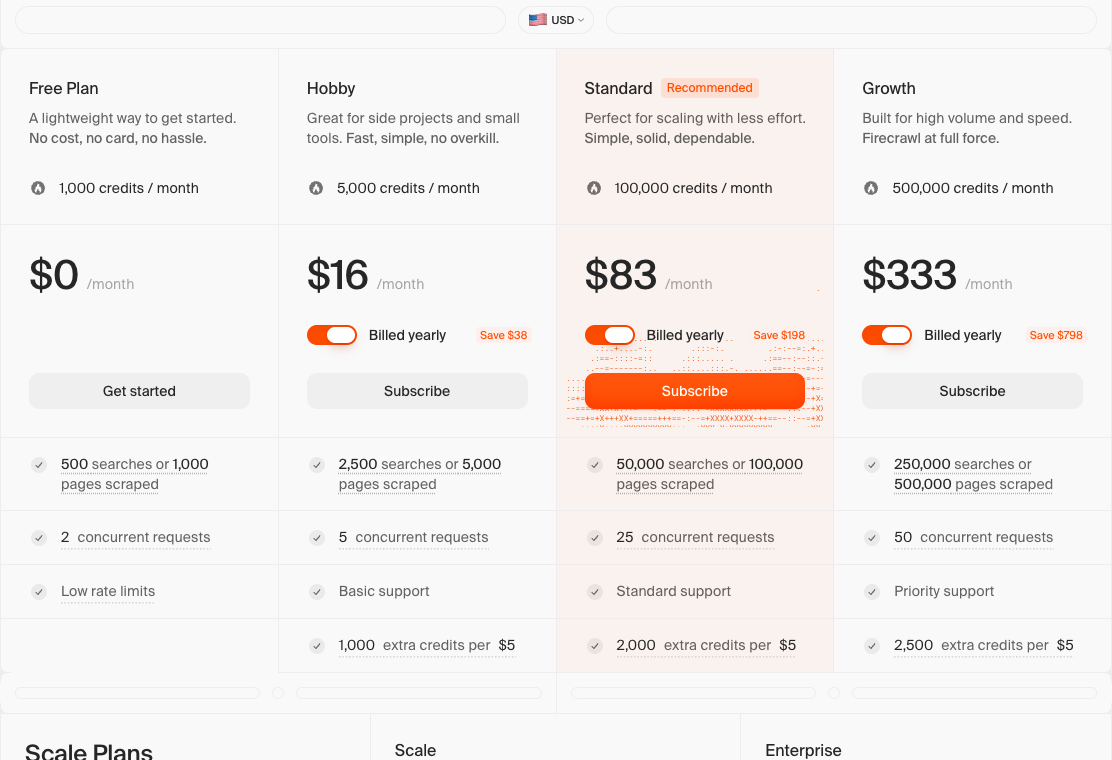
| Plan | Price (yearly billing) | Price (monthly billing) | Credits per month | Concurrent requests | Extra credits per $5 | Extra credits cost per 1,000 |
|---|---|---|---|---|---|---|
| Free | $0 | $0 | 1,000 | 2 | Not available | n/a |
| Hobby | $16/month | $19/month | 5,000 | 5 | 1,000 | $5.00 |
| Standard | $83/month | $99/month | 100,000 | 25 | 2,000 | $2.50 |
| Growth | $333/month | $399/month | 500,000 | 50 | 2,500 | $2.00 |
| Scale | $599/month | $749/month | 1,000,000 | 100 | 5,000 | $1.00 |
| Enterprise | Custom | Custom | Custom | Custom | Custom | Custom |
Three things to know before reading further:
- The headline price is the yearly one. The cards say "Billed yearly". Switch to monthly billing and Scale is $749 a month, not $599. The page's compare table shows a 16.7% saving for yearly billing on Hobby, Standard and Growth (20% on Scale). WebCrawlerAPI has no yearly discount, so the monthly column is the fair one to compare with it.
- Credits reset every month. Unused plan credits do not roll over. The exception is annual Scale, which carries unused credits over for one month.
- Free has no pay-as-you-go. When the 1,000 credits are gone, requests return HTTP 402 until the next cycle.
How Firecrawl Credits Work
A credit is the unit Firecrawl bills in. One plain page is one credit. Everything else is an add-on. This is from Firecrawl's billing docs, read the same day.
What costs 1 credit and what costs more
| Action | Credits |
|---|---|
| Scrape one page | 1 |
| Crawl, per page | 1 |
| Map a site | 1 per call |
| Search | 2 per 10 results (rounded up), plus scrape costs if results are scraped |
| JSON format (LLM extraction) | +4 per page, so 5 in total |
| PDF parsing | +1 per PDF page |
| Zero Data Retention | +1 per page |
| PII redaction, question, highlights, audio, video | +4 per page each |
| Interact (browser session) | 2 to 7 per browser minute |
| Agent | Dynamic, 5 daily runs free |
Options stack. JSON plus Zero Data Retention is 6 credits per page, and JSON plus PII redaction is 9.
The enhanced proxy costs nothing extra now. The docs say enhanced proxy requests cost the same as basic ones, 1 credit per request, and an escalated retry is not charged twice. Older posts say 5 credits. They are out of date.
What a failed page costs
What decides the charge is whether Firecrawl returned a document, not the HTTP status of the target site. If no document comes back, it costs 0 credits. If the site answered 403 or 404 and Firecrawl returned that response as a document, it costs 1 credit. The docs suggest checking metadata.statusCode to stop retrying blocked URLs.
Is Firecrawl free?
Yes, up to a limit. The Free plan gives 1,000 credits a month, which is up to 1,000 plain pages, with no card and 2 concurrent requests. Scrape, search and interact also work with no API key at all, on a keyless tier that is capped per IP address per day. Use it to try the tool, not to run a pipeline.
Cost per 1,000 Pages: Firecrawl vs WebCrawlerAPI
The formula for any credit-based plan is short:
cost per 1,000 pages = plan price / plan credits x 1,000 x credits per page
Example: Standard is $83 a month on yearly billing for 100,000 credits. $83 / 100,000 x 1,000 = $0.83 per 1,000 plain pages. With JSON extraction, the same plan is 5 credits per page, so $4.15. On monthly billing Standard is $99, so $0.99 and $4.95.
This is the script I used. It reads the prices from a small JSON file with the read date next to each number.
# cost_calc.py (shortened). Prices come from prices.json, read October 22 and 24, 2026.
def per_1k(plan, key, credits_per_page=1):
    # plan price / plan credits x 1,000 x credits per page
    return plan[key] / plan["credits"] * 1000 * credits_per_page

for p in paid_plans:
    for key in ("price_per_month_yearly_billing", "price_per_month_monthly_billing"):
        print(p["name"], key, round(per_1k(p, key), 2), round(per_1k(p, key, 5), 2))  # plain, JSON
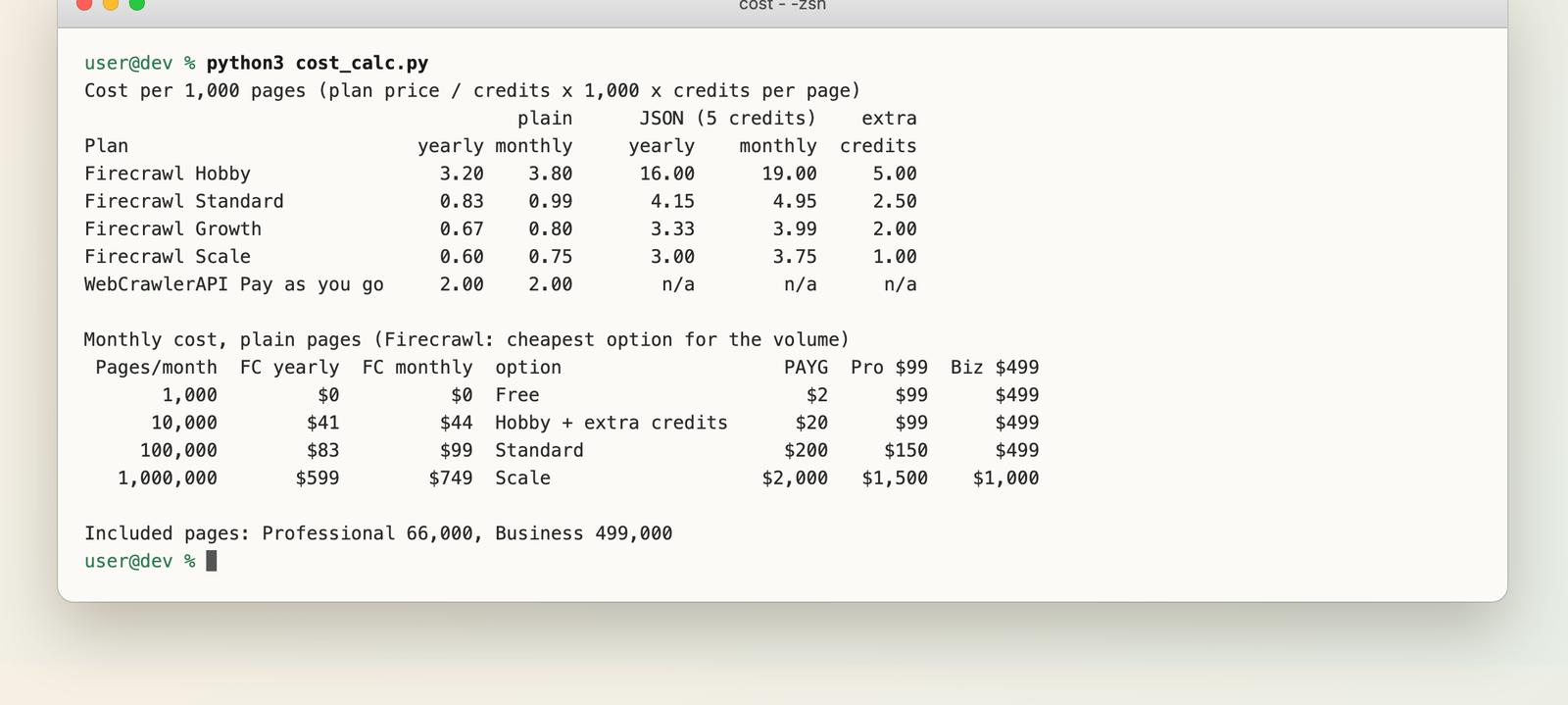
| Plan | Plain, yearly billing | Plain, monthly billing | JSON, yearly billing | JSON, monthly billing |
|---|---|---|---|---|
| Firecrawl Hobby | $3.20 | $3.80 | $16.00 | $19.00 |
| Firecrawl Standard | $0.83 | $0.99 | $4.15 | $4.95 |
| Firecrawl Growth | $0.67 | $0.80 | $3.33 | $3.99 |
| Firecrawl Scale | $0.60 | $0.75 | $3.00 | $3.75 |
| WebCrawlerAPI Pay as you go | $2.00 | $2.00 | See the prompt test below | See the prompt test below |
Figures are per 1,000 pages.
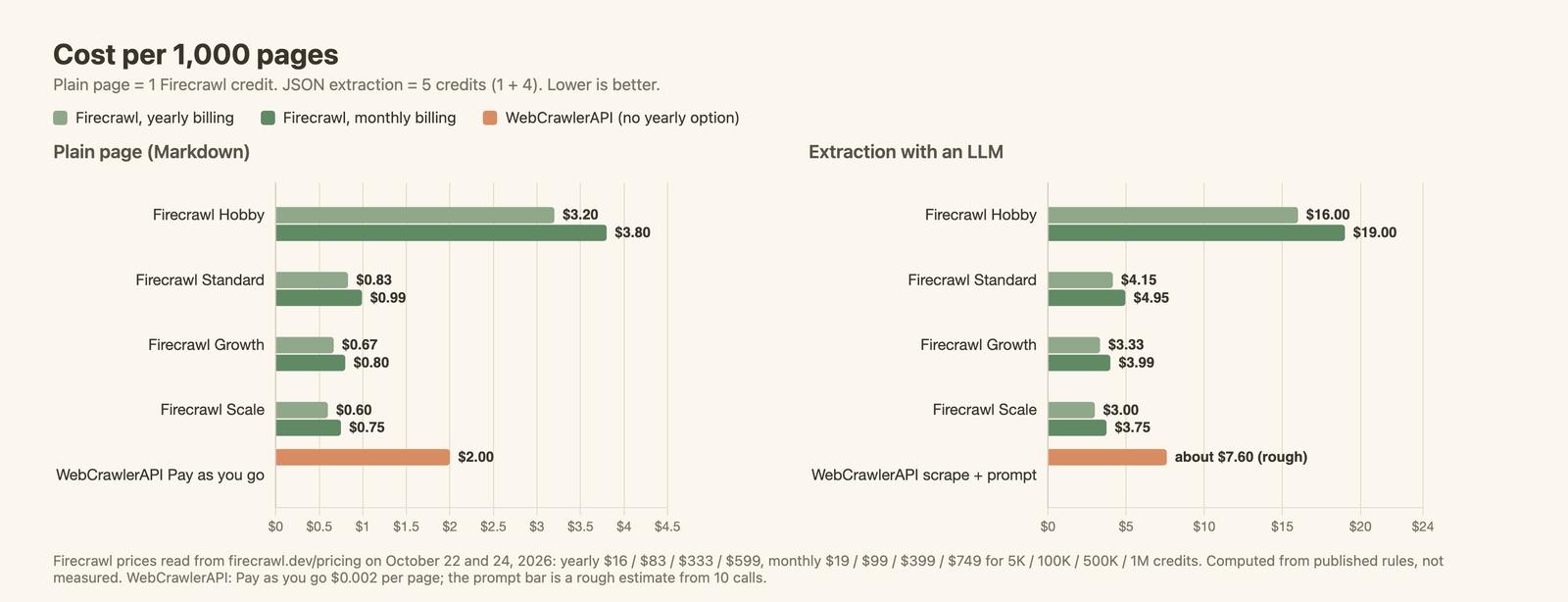
Hobby is the most expensive way to buy Firecrawl pages. It even loses to WebCrawlerAPI Pay as you go. Standard and above are 2.4 to 3.3 times cheaper than Pay as you go on yearly billing, and 2.0 to 2.7 times cheaper on monthly billing. The 5-credit multiplier on JSON extraction hurts, and it hurts most on Hobby.
WebCrawlerAPI subscription plans are different. The monthly fee is an included allowance of usage: Professional is $99 a month, which buys $99 of usage at $0.0015 per page, or 66,000 pages. Business is $499 a month at $0.001 per page, or 499,000 pages. Beyond the allowance, pages are charged at the plan's rate from the prepaid balance. The monthly cost is the larger of the fee and pages x rate, and the table in the monthly section below uses that. See the pricing docs and the pricing section. The docs do not say whether an unused allowance carries over, so I do not claim either way.
What I Measured on the WebCrawlerAPI Side
Only the WebCrawlerAPI numbers in this section are measured. The calls ran on October 22, 2026 against public practice sites (books.toscrape.com and quotes.toscrape.com), five requests at a time at most.
One limit up front: the /v2/scrape response has no cost field. I read the account balance, which has two decimals and posts late (a charge can show up a minute or more after the call). So the numbers are balance changes, checked against the total once everything settled.
Experiment A: billed cost for 20 pages
Ten static pages (books.toscrape.com/catalogue/page-1.html to page-10.html) and ten JavaScript-rendered pages (quotes.toscrape.com/js/page/1/ to page/10/) through POST /v2/scrape with Markdown output and max_age set to 0. All 20 returned HTTP 200 with content (1,344 to 6,183 Markdown characters each, so none came back empty).
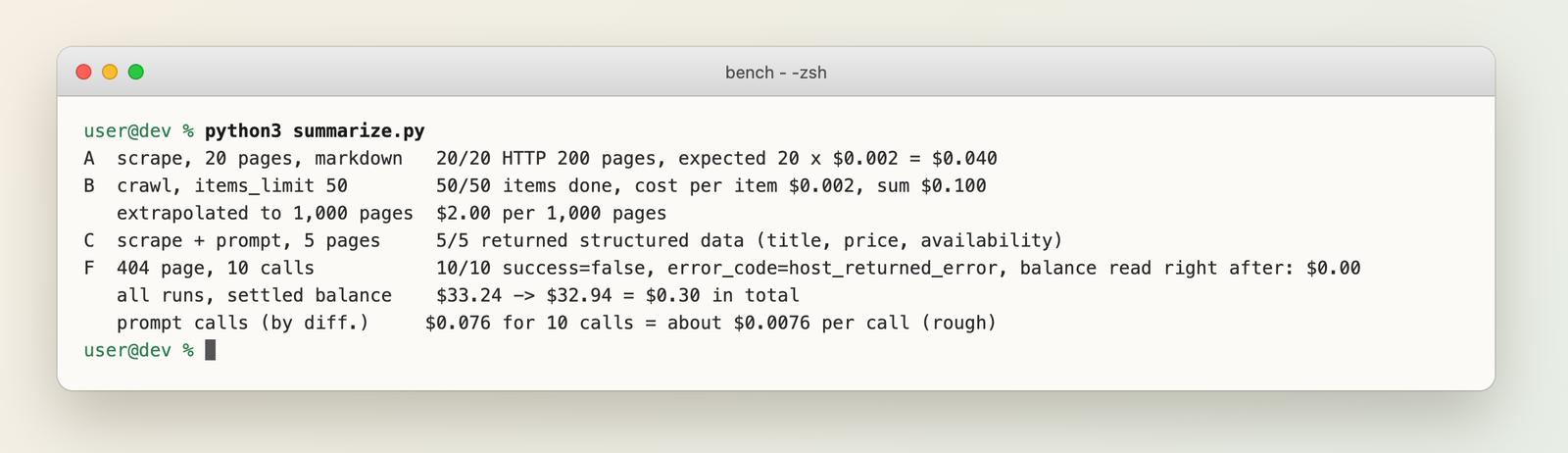
The balance read $0.00 lower right after the run, because the charge had not posted yet. So I could not read a per-run cost here. The expected cost is 20 x $0.002 = $0.04, and the final settled total (below) covers this run, a repeat of it and two probe calls.
Experiment B: crawl 50 pages
POST /v1/crawl on https://books.toscrape.com/ with items_limit set to 50. The job finished with 50 of 50 items done, and every item had cost 0.002 (the field is in dollars). The sum is $0.10, which extrapolates to $2.00 per 1,000 pages. That is an extrapolation from 50 pages, not a 1,000-page run.
Experiment C: extraction with a prompt
Five book pages through /v2/scrape with a prompt ("Extract the book title, the price and the availability."). All five returned structured data, for example title "A Light in the Attic" and availability "In stock (22 available)".
I ran the five calls twice. After the ledger settled, the whole session cost $0.30 (balance $33.24 to $32.94). That is 42 scraped pages ($0.084, the two runs plus two probe calls), 50 crawled pages ($0.10), 20 failed-page calls ($0.04, see below) and 10 prompt calls. Subtract the first three ($0.224) and about $0.076 is left for the prompt calls, so roughly $0.0076 per call, page included. That is about $7.60 per 1,000 pages. The sample is 10 calls and the balance has a $0.01 resolution, so treat it as rough. The docs say agent tokens run about $0.004 to $0.02 per page on top of the page rate.
Against Firecrawl's 5-credit JSON rule, the same page costs about $0.016 on Hobby, $0.00415 on Standard and $0.003 on Scale with yearly billing ($0.019, $0.00495 and $0.00375 monthly). So prompt extraction on WebCrawlerAPI is cheaper than Firecrawl Hobby and dearer than Standard and up, going by this rough number. The outputs are not the same, so this is a price comparison only.
What a failed page cost
I scraped https://books.toscrape.com/catalogue/nope.html 10 times, and repeated the run once. Each call returned success: false with error_code host_returned_error. When the site itself answers 404, WebCrawlerAPI bills the call like a normal page, the same way Firecrawl bills a returned 404 as 1 credit. The balance read right after my run had not moved, but it was simply read too early. The 20 calls are counted in the settled total above, at $0.002 each.
Here is the Node version of the scrape check:
// Node 18+. Scrape is /v2/scrape, crawl is /v1/crawl (different versions).
const headers = { Authorization: `Bearer ${process.env.WEBCRAWLER_API_KEY}`, "Content-Type": "application/json" };

const res = await fetch("https://api.webcrawlerapi.com/v2/scrape", {
  method: "POST",
  headers,
  body: JSON.stringify({ url: "https://books.toscrape.com/", output_formats: ["markdown"], max_age: 0 }),
});
const data = await res.json();
console.log(res.status, data.success, data.markdown.length, "markdown chars");

// The balance has 2 decimals and posts late, so wait before reading it.
const bal = await fetch("https://api.webcrawlerapi.com/organization/balance", { headers });
console.log((await bal.json()).total_balance);
And the crawl call, in Python:
import os, requests

H = {"Authorization": "Bearer " + os.environ["WEBCRAWLER_API_KEY"]}
# Crawl is /v1/crawl, while scrape above is /v2/scrape.
job = requests.post("https://api.webcrawlerapi.com/v1/crawl", headers=H,
                    json={"url": "https://books.toscrape.com/", "items_limit": 50}).json()
# Poll GET /v1/job/<id> until status is "done", then add up job_items[].cost
Monthly Cost at 1K, 10K, 100K and 1M Pages
Plain pages, Firecrawl on its cheapest option for the volume (extra credits allowed, yearly and monthly billing), against the three WebCrawlerAPI options. For Professional and Business, the monthly cost is the larger of the fee and pages x rate.
| Pages per month | Firecrawl, yearly billing | Firecrawl, monthly billing | WebCrawlerAPI Pay as you go | Professional ($99) | Business ($499) |
|---|---|---|---|---|---|
| 1,000 | $0 (Free, exactly at the cap) | $0 | $2 | $99 | $499 |
| 10,000 | $41 (Hobby $16 + 5,000 extra credits at $5 per 1,000) | $44 (Hobby $19 + $25) | $20 | $99 | $499 |
| 100,000 | $83 (Standard) | $99 (Standard) | $200 | $150 | $499 |
| 1,000,000 | $599 (Scale) | $749 (Scale) | $2,000 | $1,500 | $1,000 |
The subscriptions only pay off against Pay as you go above 66,000 pages a month (Professional) and 499,000 (Business). Below that, the fee is the cost, and Pay as you go is cheaper. Even above it, Firecrawl is still cheaper at 100,000 pages ($83 or $99 against $150) and at 1,000,000 ($599 or $749 against $1,000 on Business). The Firecrawl column is computed, not measured.
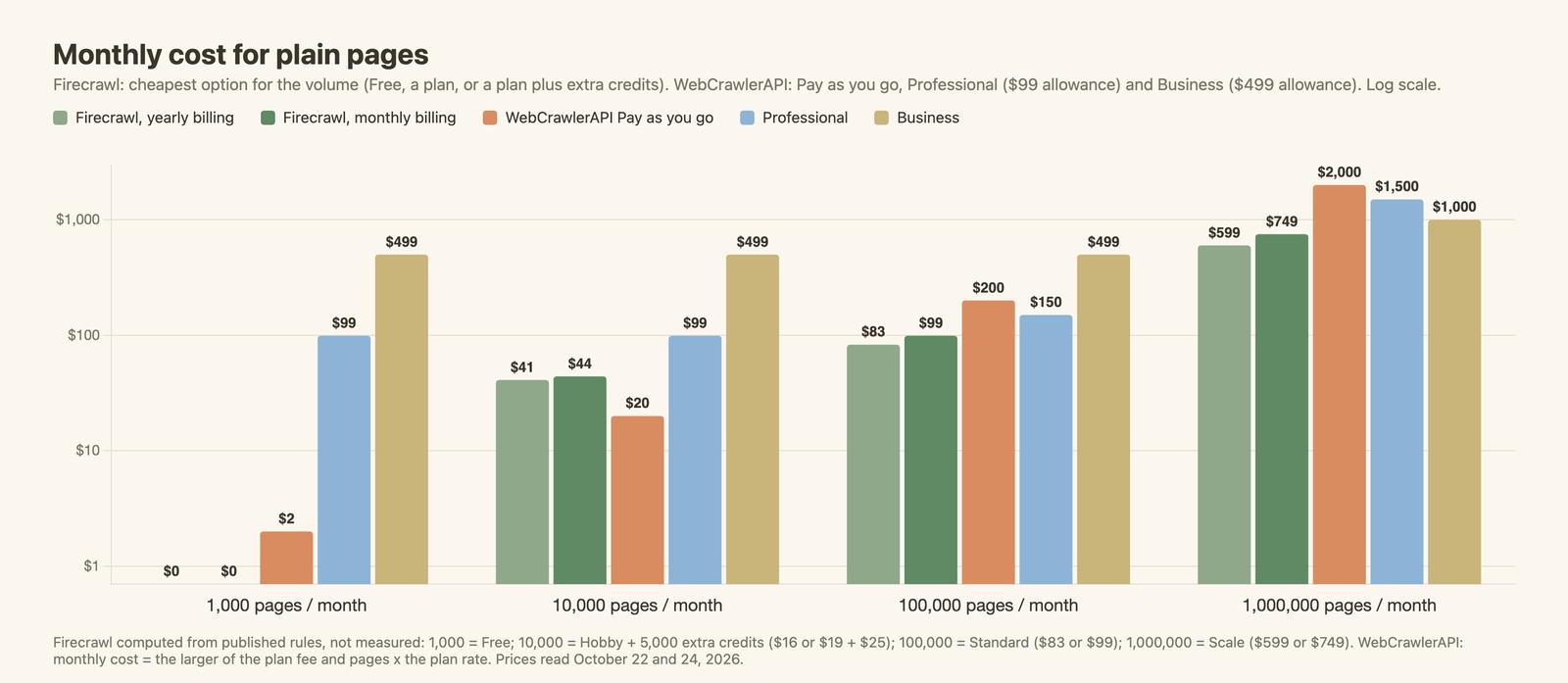
Standard at 10,000 pages would be $83 ($99 monthly), so Hobby plus extra credits is the cheaper Firecrawl route there.
A knowledge-base crawl scenario
Say a 1,000-page docs site is recrawled every week. That is about 4,300 pages a month (see how often to recrawl for the cadence logic, and docs site to knowledge base for a worked example).
- Firecrawl: above the Free cap, so Hobby at $16 ($19 monthly). The 5,000 credits cover it, and 700 credits (14%) go unused.
- WebCrawlerAPI Pay as you go: 4,300 x $0.002 = $8.60.
Recrawl daily instead, about 30,000 pages a month. Firecrawl needs Standard at $83 ($99 monthly). Pay as you go would be $60, and Professional $99 (the fee, since 30,000 pages is under its 66,000 allowance). So in this range, WebCrawlerAPI Pay as you go is the cheaper one.
Spiky use is a similar case. If a team crawls 3,000 pages in one month and nothing the next, it pays $16 ($19 monthly) for Hobby, whose credits reset every month with no rollover, against $6 on Pay as you go. The Pay as you go balance does not expire, so nothing is lost in the quiet month. Firecrawl says purchased credits stay until used, but expire if you cancel the plan.
Where Firecrawl is the better buy
- 100,000 pages a month and up. It is 2.4 to 3.3 times cheaper per plain page on yearly billing, 2.0 to 2.7 times on monthly.
- Up to 1,000 pages a month. Free is $0.
- JSON extraction on Standard and above. The 5-credit rule still comes out under $0.005 a page, even on monthly billing.
- Concurrency. Firecrawl publishes 5 to 100 concurrent requests by plan. For WebCrawlerAPI, see rate limits.
- Speed and success rate in my own benchmark. Firecrawl's median was 3.6 seconds against 8.5 for WebCrawlerAPI, with a success rate of 89.70% against 87.97% on 806 URLs. WebCrawlerAPI scored higher on Markdown quality (F1 0.623 against 0.539), but that is for the /markdown endpoint at $0.006 per page on Pay as you go, not the $0.002 /scrape. See the scrape quality benchmark. We built that benchmark, so take it with some caution.
Hidden Costs and Gotchas
Firecrawl
- Yearly billing is the headline price. Monthly costs more: Hobby $19, Standard $99, Growth $399, Scale $749.
- Credits reset monthly and do not roll over, except annual Scale (one month).
- Free stops with HTTP 402 when credits run out. Pay-as-you-go needs a paid plan and a monthly limit you set. Without a limit, it keeps charging in $5 steps.
- Pay-as-you-go has an overage allowance, so a burst can run past zero: 1,500 credits on Hobby, 30,000 on Standard, 150,000 on Growth, 600,000 on Scale.
- Purchased credits expire if you cancel the plan, at the end of the billing period.
- A returned 403 or 404 page still costs 1 credit.
- Search results that are scraped add per-page costs. x.com and some LinkedIn URLs are priced separately.
- The keyless free tier is capped per IP address per day.
WebCrawlerAPI
- Some sites (TikTok, LinkedIn public pages and a few others) are priced separately from the standard rate.
- /markdown (LLM-cleaned) is $0.006 per page on Pay as you go.
- A prompt adds LLM tokens to the page rate. My rough sample came to about $0.0076 per page, page included.
- A 404 answer from the site is billed like a normal page, as on Firecrawl.
- Professional and Business fees are an included allowance. I do not know whether an unused allowance carries over.
- I found no cost field in the /v2/scrape response, only in crawl job items, so per-call cost on scrape has to be read from the balance.
Firecrawl vs WebCrawlerAPI: Which Is Cheaper for You?
| Your case | Cheaper | Why |
|---|---|---|
| 1,000 pages a month or less | Firecrawl Free | $0, no card |
| About 3,000 to 30,000 pages a month, recrawl cycles | WebCrawlerAPI Pay as you go | $6 to $60, against $16 to $99 for a plan, and the balance does not expire |
| 66,000 to 499,000 pages a month, plain pages | WebCrawlerAPI Professional beats Pay as you go, but not Firecrawl | $99 to $150, against $83 to $99 for Firecrawl Standard at 100,000 |
| 499,000 pages a month or more, plain pages | Firecrawl Scale | $599 to $749 at 1,000,000, against $1,000 on Business |
| 100,000 pages a month or more, plain pages | Firecrawl Standard, Growth or Scale | $0.60 to $0.99 per 1,000 |
| JSON extraction at volume | Firecrawl Standard and above | 5 credits is $0.003 to $0.00495 per page |
| Many concurrent requests | Firecrawl | Published tiers go to 100 |
If neither fits, read Firecrawl alternatives. For a wider list, see best web scraping tools, best web crawler API, ScrapingBee alternatives, open source crawlers, and for LLM extraction costs, AI web scraping.
What I Did Not Test
Firecrawl was not run, so its numbers are computed from the rules published on October 22 and 24, 2026. Speed, quality and concurrency are only mentioned by link. The samples are small: 20 pages, a 50-page crawl and 10 prompt calls. The WebCrawlerAPI balance has two decimals and posts late, so per-call figures are averages, and the prompt figure is a rough difference. I did not model Firecrawl's extract and agent pricing or self-hosting costs.
FAQ
How much does Firecrawl cost?
Free is $0 for 1,000 credits a month. The paid plans are Hobby $16 (5,000 credits), Standard $83 (100,000), Growth $333 (500,000) and Scale $599 (1,000,000), all per month on yearly billing. Billed monthly they are $19, $99, $399 and $749. One plain page is one credit, so that is $0.60 to $3.20 per 1,000 pages on yearly billing and $0.75 to $3.80 on monthly.
Is Firecrawl free? Can I use Firecrawl for free?
Yes, for up to 1,000 credits a month, with no card. After that, requests return HTTP 402 on the Free plan. A keyless tier also exists, capped per IP address per day.
How many pages do I get per Firecrawl credit?
One plain page per credit. JSON extraction is 5 credits per page, and other options add more. A returned 404 page also costs 1 credit.
Is there a Firecrawl coupon code?
Firecrawl's billing docs describe two kinds. Subscription coupons apply at checkout only, and credit coupons are redeemed in the dashboard billing section. The pricing page shows a saving for yearly billing (16.7% in its compare table for Hobby to Growth). I know of no public code, and I will not invent one.
What is the cheapest web scraping API?
It depends on volume. Firecrawl is cheapest per plain page from 100,000 pages a month in this comparison, and WebCrawlerAPI Pay as you go is cheaper in the 3,000 to 30,000 range. The Professional and Business plans only beat Pay as you go above 66,000 and 499,000 pages. Other vendors have different models, see best web scraping APIs.
Is Firecrawl worth it?
For high volumes of plain pages, yes, the numbers above favor it. For a small knowledge-base crawl that runs weekly, Hobby at $16 leaves credits unused and can cost more than pay-as-you-go. Test 50 of your own URLs on both before deciding.
Is Firecrawl open source? Can I self-host it?
Firecrawl describes itself as open source and also sells a hosted service. I did not check the licence terms, so read its LICENSE file before self-hosting. Self-hosting is not free in infrastructure. See open source web crawlers.
Is web scraping legal?
It depends on the data, the site's terms and where you are. Read web scraping ethics before you start.
Pick One and Test It
If you are also looking at Apify, its usage-based pricing behaves very differently from credits. See Apify vs Firecrawl for both models and a 200 URL test.
Run 50 of your own URLs through both. The WebCrawlerAPI pricing docs list the per-page rates, and the web scraping API page shows how to start. For Firecrawl, check the pricing page on the day you buy, because it changes often. If you are also weighing Apify's usage-based model, see Apify vs Firecrawl.